Quick Answer
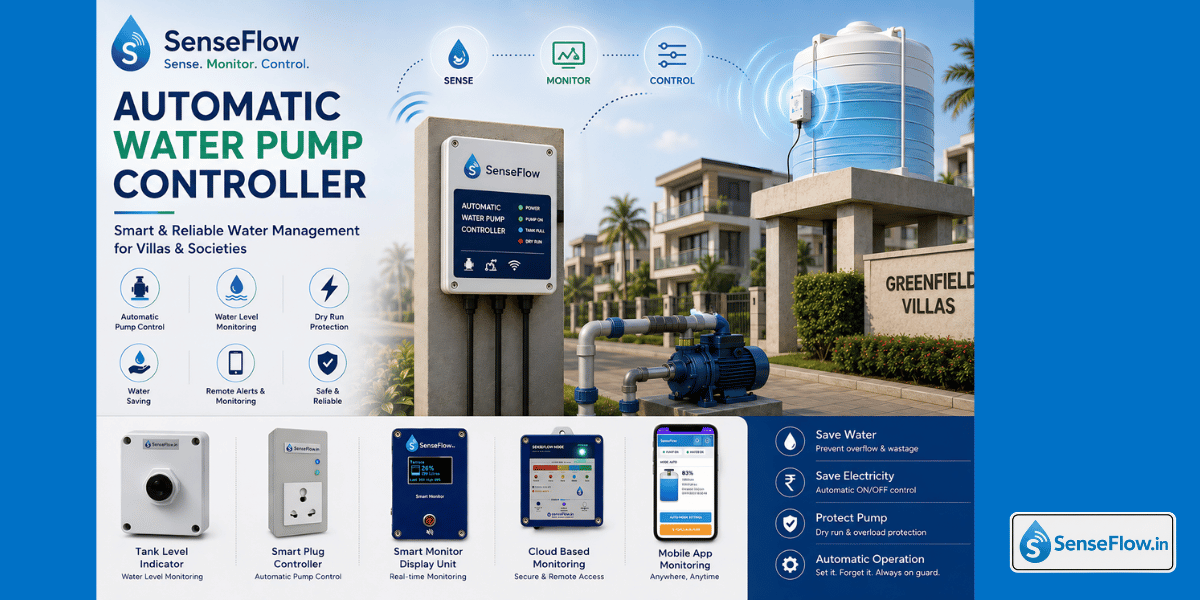
Indian municipal water supply is different from one locality to another. In some homes water arrives at fixed morning, afternoon, or late-night timings. In other areas it arrives without warning, starts with air in the pipe, or brings dirty first water for a few minutes. SenseFlow automatic pump controllers solve these problems by combining schedule operation, tank-level automation, source water detection, retry logic, valve control, and monitoring in one smart system.
Water management in India is not a simple "turn the pump on and off" problem. A home in one city may receive corporation water every morning. Another apartment may get water in the afternoon when everyone is at work. Some areas receive municipal supply late at night when the entire family is sleeping. In many localities, the timing is not fixed at all.
This is why a basic timer is often not enough. A proper automatic water pump controller can switch a pump at a fixed time, but it also understands whether water is actually present, whether the overhead tank already has enough water, whether the pipe contains air, or whether the first few minutes of supply should be flushed before filling the tank.
SenseFlow is built around these real Indian water conditions. The goal is simple: make sure water is available to your property, reduce manual checking, protect the pump, and give families, building managers, and security teams complete peace of mind.
Why Indian Municipal Water Supply Needs Smarter Control
Across Indian homes, buildings, and societies, municipal or corporation water often follows one of these patterns:
Fixed Time Supply
Water comes at a known time, such as morning, afternoon, or night, but someone still has to operate the pump manually.
Inconvenient Timing
Supply may come when people are in office, travelling, cooking, sleeping, or busy with daily work.
Air Before Water
At the scheduled time, the pipeline may first contain air or low-pressure flow before real water reaches the source line.
Irregular Anytime Supply
In some areas, source water can arrive at any time, so fixed schedules are not reliable enough.
When water supply is missed, the overhead tank may remain empty. When the pump is left running, the tank may overflow. When the pump runs without source water, the motor can heat up and get damaged. These are exactly the gaps smart automation should handle.
Scenario 1: Water Comes at a Fixed Time
Many households know their approximate water supply window. It may be early morning, afternoon, evening, or late at night. The problem is not knowing the timing; the problem is being available at that exact timing every day.
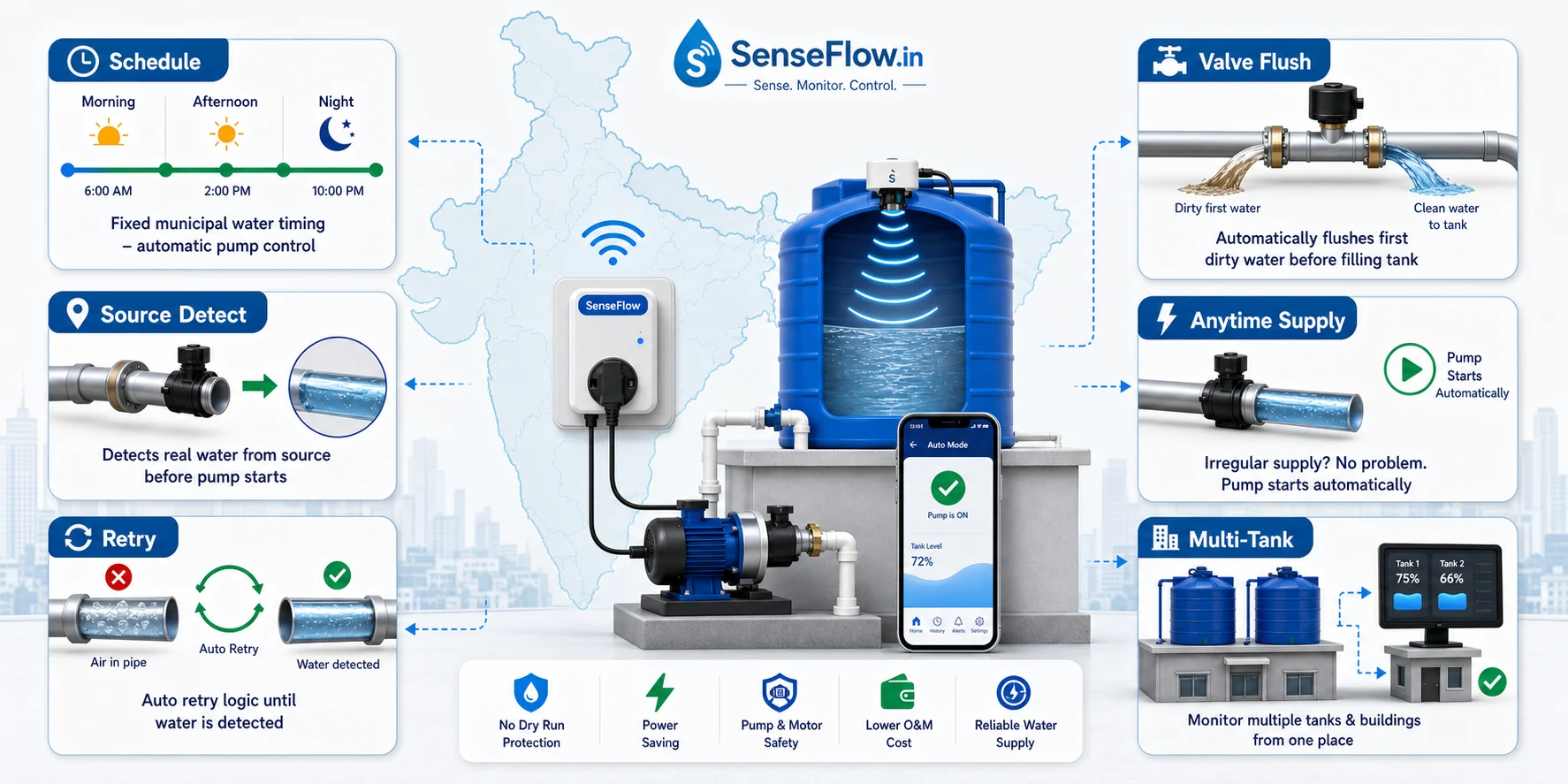
With SenseFlow, the user can set a schedule window. During that window, the controller checks tank levels and runs the pump only when required. If the overhead tank is already full or above the user-set level, the pump does not needlessly run. If the tank needs water, the controller starts the pump and stops it automatically when the desired level is reached.
| Common Situation | SenseFlow Response |
|---|---|
| Water comes at 7 AM while the home is busy. | Scheduled operation starts automatically and fills only if the tank needs water. |
| Water comes at 3-4 PM while people are at work. | The pump can operate during the scheduled window without anyone being home. |
| Water comes at 1 AM when everyone is sleeping. | The controller can handle the filling cycle without waking anyone up. |
Scenario 2: Schedule Is Fixed, But Water Is Not Present Immediately
In many municipal lines, the scheduled time does not always mean usable water starts immediately. For the first few minutes, there may be air in the pipe, very low pressure, or delayed water arrival. A normal timer will switch the pump on anyway. That can lead to dry running or repeated manual checking.
SenseFlow can be combined with source water detection so the controller does not depend only on clock time. The schedule tells the system when to be ready. The source sensor — typically a reliable ultrasonic or DIP sensor — confirms whether real water is present.
For such sites, SenseFlow municipal or corporation-focused configurations can be customised to test the line, wait, retry, and then start normal pump operation only when source water is detected. Once water is confirmed, the controller follows tank-level logic and fills the overhead tank up to the level selected by the user.
How Retry Logic Helps
- The schedule window begins.
- The system checks whether source water is present.
- If there is air or no water, the controller waits or retries based on the configured setting.
- When source water is detected, automatic pump operation begins.
- The pump stops when source water disappears or the overhead tank reaches the set level.
Scenario 3: No Fixed Timing, Water Can Come Anytime
Some homes and remote localities cannot depend on a fixed municipal schedule. Water may arrive at uncertain times due to line pressure, borewell availability, local pumping cycles, or area-level distribution patterns. In this case, schedule-only automation is not enough.
SenseFlow source detection based automation is useful here. Instead of waiting for a fixed time, the controller watches for source water availability. Whenever source water is detected, the system can start pump operation automatically, continue filling as long as the source is available, and stop when the overhead tank reaches the set level.
This can work as a repeated cycle: detect source water, fill tank as needed, stop safely, and remain ready for the next water arrival. The same controller can combine tank-level sensing, source water detection, and pump control to reduce manual effort in difficult supply conditions.
Scenario 4: Dirty First Water Needs to Be Flushed
In some critical areas, the first few minutes of municipal water may carry impurities, settled particles, or discoloured water from the pipeline. Many users prefer not to send this first flow into the overhead tank.
For such installations, SenseFlow Node or valve-based editions can be designed to open a solenoid valve before motor operation. The valve can flush the first water for a fixed time. After the configured flush period, pump operation can begin normally and continue until the tank fills to the selected level.
This setup is site-dependent and should be planned properly, but it is a powerful option for properties where the first water quality is a repeated concern.
Scenario 5: Multiple Overhead Tanks With One Pump
Many buildings have more than one overhead tank but only one pump. Filling all tanks manually can be confusing: one tank may overflow while another stays low, or a security guard may need to follow a repeated routine every day.
SenseFlow can support multi-tank planning based on the actual site. Depending on plumbing and electrical design, automation may use tank-level inputs, valve-based filling, or monitoring dashboards. The aim is to fill tanks based on their levels instead of guesswork.
Scenario 6: Monitoring Only for Buildings and Security Teams
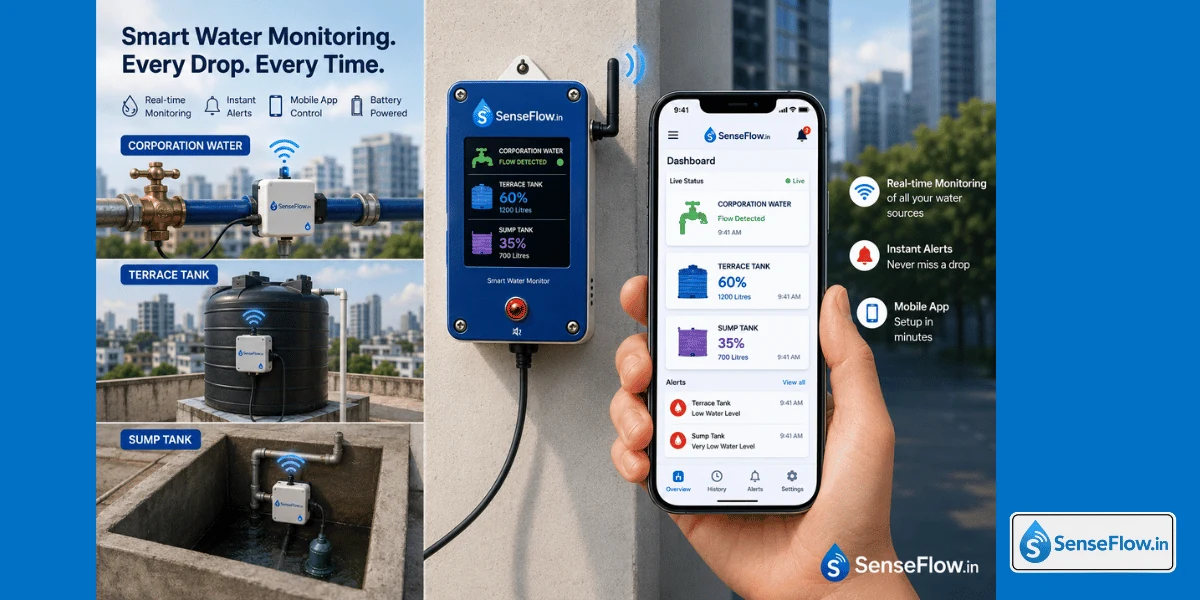
Not every property needs full automation on day one. Some buildings only need better visibility. Security guards or maintenance staff may need to know tank levels, water arrival, or alarm status so they can follow an existing routine more reliably.
SenseFlow Monitor helps in such cases by showing tank levels and alerts in a simple way. It can support building routines, reduce unnecessary tank checking, and make water status visible from one place.
Which SenseFlow Method Fits Which Water Problem?
| Water Problem | Best Automation Method | Why It Helps |
|---|---|---|
| Known daily water timing | Schedule + tank-level automation | Runs only during the supply window and stops at the selected tank level. |
| Air in pipe before water arrives | Schedule + source detection + retry | Waits for real source water before normal pump operation. |
| No fixed supply timing | Source detection based auto operation | Starts when source water is available and stops safely when needed. |
| Dirty first water | Solenoid valve flush + pump automation | Flushes initial water before filling the overhead tank. |
| Multiple overhead tanks | Multi-tank level sensing or valve logic | Fills tanks based on actual level instead of manual guessing. |
| Security guard routine | Monitoring display and alerts | Makes water levels visible and easier to manage from one place. |
Why This Is More Than a Pump Timer
A timer only understands time. SenseFlow can understand time, tank level, source water presence, retry conditions, and site-specific control logic. That difference matters in Indian water supply conditions because the real problem is rarely one-dimensional.
A well-configured controller can help avoid missed supply, reduce overflow, protect the motor from dry run conditions, and reduce daily dependence on manual checking. For many customers, this means better sleep, fewer interruptions, better productivity, and more reliable water availability for the property.
Frequently Asked Questions
Can SenseFlow run the pump automatically at municipal water supply time?
Yes. The controller can operate during user-defined schedule windows and fill the overhead tank based on tank levels.
Can the pump start only if source water is present?
Yes, when the setup includes source water detection. This helps prevent the pump from running when the source line does not have water.
What if water comes late during the scheduled window?
Retry settings can be customised for suitable installations. The system can wait, check again, and begin normal operation when source water is detected.
Can SenseFlow handle water that comes at any time?
Yes. Source detection based operation can trigger pump automation whenever water is present, even if there is no fixed timing.
Can dirty first water be bypassed?
In suitable valve-based installations, a solenoid valve can flush initial water for a set time before pump filling begins.
Can the same system work for buildings with multiple tanks?
Yes, depending on the plumbing and wiring design. Multi-tank filling may use tank sensors, valve logic, monitoring, or a combination of these.
Conclusion
Indian water supply problems are different in every area, but the goal is the same everywhere: water should be available when needed, the pump should stay protected, and people should not have to plan their day around the motor switch.
SenseFlow solves this with smart automation built around real conditions: scheduled operation, source detection, retry logic, valve flushing, tank-level control, multi-tank planning, and monitoring. Whether your water comes in the morning, afternoon, late night, or at an unpredictable time, a properly selected SenseFlow setup can make water management calmer, safer, and more reliable.
Facing a Municipal Water Timing Problem?
Share your water timing, tank setup, pump location, and source condition. SenseFlow will help you choose the right automation logic.